
MCAT Scores, Results Release Dates & Percentiles
Everything you need to know about MCAT scores and MCAT results release dates — from section scales and percentiles to what makes a good score for your med school application.
How MCAT Scores Work
The MCAT scoring system is unique among standardized tests. Understanding its structure is the first step toward setting realistic goals and building an effective study plan.
118–132 Per Section, 472–528 Total
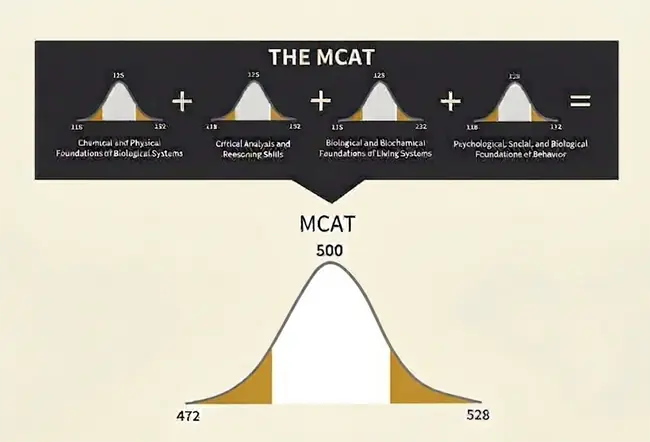
Each of the four scored sections of the MCAT — Chemical and Physical Foundations (Chem/Phys), Critical Analysis and Reasoning Skills (CARS), Biological and Biochemical Foundations (Bio/Biochem), and Psychological, Social, and Biological Foundations (Psych/Soc) — is scored on a scale from 118 to 132. The midpoint of each section is 125.
Your total MCAT score is the sum of all four sections, ranging from 472 to 528 with a midpoint of 500. The scoring system was designed so that a 500 represents the 50th percentile — meaning a score of 500 indicates you performed better than approximately half of all test-takers.
Important: Raw scores (the number of questions you answer correctly) are converted to scaled scores through a statistical process called equating. This ensures that scores are comparable across different test dates, even if one version of the exam was slightly harder than another.
MCAT Percentiles: Average MCAT Score Ranges
The table below shows approximate percentile rankings for common total MCAT score ranges. Percentiles indicate what proportion of test-takers scored at or below a given level.
| Total Score | Approximate Percentile | Competitiveness |
|---|---|---|
| 524–528 | 99th–100th | Elite — top research institutions and the most selective programs |
| 519–523 | 96th–99th | Exceptional — highly competitive for top-20 medical schools |
| 515–518 | 90th–95th | Very strong — competitive for top-tier programs |
| 511–514 | 80th–89th | Strong — competitive for most MD programs nationwide |
| 508–510 | 72nd–79th | Above average — meets the threshold for many MD schools |
| 504–507 | 60th–71st | Average — competitive for DO programs and some MD programs |
| 500–503 | 49th–59th | Below the median for MD applicants — competitive for many DO schools |
| 496–499 | 35th–48th | Below average — may limit options; retake often recommended |
| 492–495 | 22nd–34th | Low — significant improvement needed for most programs |
| 472–491 | 1st–21st | Very low — comprehensive preparation and retake strongly advised |
Note: Percentile rankings shift slightly from year to year as the testing population changes. The figures above are approximate and based on recent AAMC data. Always consult the official AAMC percentile tables for the most current information.
What Is a Good MCAT Score for Medical School?
The answer depends on where you want to attend medical school, but here are some widely recognized benchmarks.
508+ for Most MD Schools
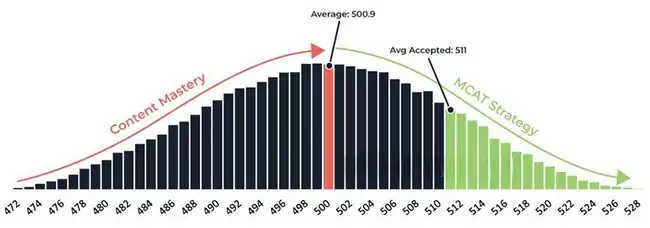
A total score of 508 or higher places you above the 72nd percentile and meets or exceeds the median score for matriculants at a wide range of allopathic (MD) medical schools across the United States. For DO programs, a score in the 504–506 range is typically competitive.
515+ for Top Programs
If you are aiming for a top-20 medical school or a highly competitive specialty, you will want a score of 515 or above (90th percentile or higher). At these programs, the average matriculant score often falls between 517 and 522.
Balanced Section Scores
Admissions committees look at your individual section scores, not just the total. A 512 with all four sections at 128 is generally viewed more favorably than a 512 with one section at 132 and another at 124. Consistency across sections signals well-rounded readiness.
How MCAT Scores Are Reported
Understanding the score report timeline and what appears on your record helps you plan your application strategy.
MCAT Score Release Dates
MCAT scores are released approximately 30 to 35 days after your test date. Scores are released by 5:00 PM ET on the scheduled release date. The Association of American Medical Colleges (AAMC) publishes specific score release dates each year. See the full 2026 MCAT test dates & score releases schedule. Results are posted to your AAMC account and you will receive an email notification.
What Your Report Includes
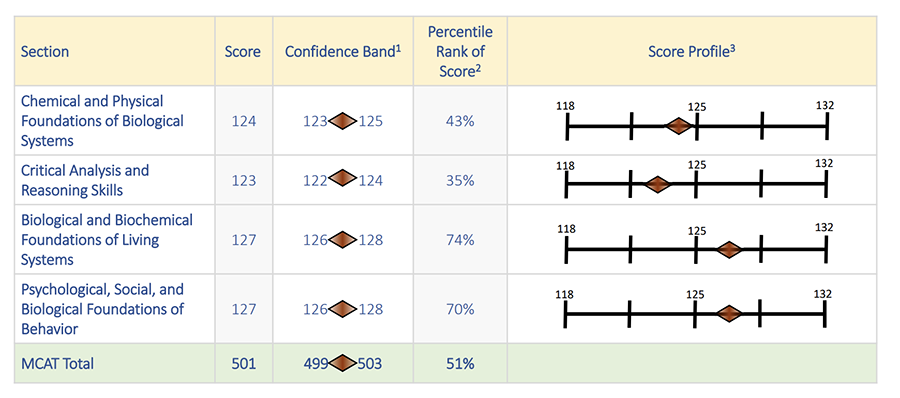
Your score report shows your scaled score (118–132) and percentile rank for each of the four sections, plus your total scaled score and total percentile rank. It also includes a confidence band for each score, reflecting the margin of statistical uncertainty. Medical schools receive the same information when you authorize score release through AMCAS.
Void vs. Score
At the end of your MCAT test day, you are given the option to void your exam or have it scored. If you void, no score is recorded and medical schools will never see the attempt — though the voided attempt still counts toward your lifetime testing limits. If you feel your performance was significantly below your practice scores, voiding can be a strategic decision.
Score History & Retakes
All scored MCAT attempts within the most recent three years are visible to medical schools. You can take the MCAT up to three times in a single testing year, four times over two consecutive years, and seven times in a lifetime. Schools see every scored attempt, so performing well on your first try is always preferable.
Understanding Your MCAT Results Release Date
Waiting for your MCAT results can feel stressful. Here is what to expect on your MCAT results release date and how to plan around it.
How Long Until Results Are Released?
MCAT results are typically released 30 to 35 days after your test date. The AAMC publishes the exact release date for each exam at the start of the testing cycle. Scores go live at 5:00 PM Eastern Time on the release date. You will receive an email from AAMC when your results are available.
Where to Check Your Results
Log in to your AAMC account at students-residents.aamc.org on or after the release date. Your score report will appear under the MCAT section. The report includes section scores, total score, percentile ranks, and confidence bands.
Planning Your Application Timeline
If you are applying in the current cycle, make sure your MCAT results release date falls before AMCAS opens or shortly after. Many applicants aim to have their scores in hand by late May or early June. Testing too late in the cycle can delay your application and reduce your chances at competitive medical school programs.
What If Your Results Are Lower Than Expected?
If your MCAT results are below your target, you have options. You can retake the exam (up to 3 times per year), though most medical schools will see all scored attempts. Dr. Donnelly offers focused retake programs that target your weakest sections and help you improve efficiently.
How to Improve Your MCAT Score
Whether you are preparing for your first attempt or planning a retake, these principles drive the biggest score gains.

Diagnose Before You Study
Taking a diagnostic practice exam is essential, but it is only the starting point. The real value comes from a detailed analysis of which question types and content areas you missed, and why. Were your errors caused by content gaps, misreading the question, poor timing, or faulty reasoning? Each root cause requires a different fix.
Target Your Weakest Areas
Many students spend excessive time reinforcing subjects they already know well while avoiding the topics that make them uncomfortable. Deliberate, focused practice on your weakest content areas and question types yields far greater point gains than reviewing material you have already mastered.
Review Every Practice Question
The single most effective study habit for the MCAT is thorough review of practice questions — not just the ones you got wrong, but also the ones you got right. Understanding why each answer choice is correct or incorrect builds the deep comprehension that the exam demands.
Work with an Expert Tutor
A skilled tutor can accelerate your score improvement dramatically by identifying blind spots you cannot see yourself, teaching passage strategies that are not available in textbooks, and holding you accountable to a structured study schedule. Dr. Donnelly's students typically gain 10 to 15 points on their composite score.
MCAT Scores & Results FAQs
When are MCAT results released?
How do I register for the MCAT?
What MCAT score do I need for medical school?
How long should I study before taking the MCAT?
Should I retake the MCAT if my score is low?
Ready to Reach Your Target MCAT Score?
Schedule a free 30-minute consultation with Dr. Donnelly. He will evaluate your current score, identify your biggest opportunities for improvement, and outline a personalized study plan.